
The Blue Line
An urban tour to help you discover the city of Hamilton!
An urban tour to help you discover the city of Hamilton!

About La ligne bleue
Set out to discover The Blue Line, an interactive walking tour that invites you to explore all aspects of Hamilton.
From public art to heritage sites, historic alleyways, remarkable architecture, and culinary diversity, each stop offers a window into the city’s history and cultural richness. You’ll also discover the vital contribution immigrant communities have made to Hamilton’s growth and prosperity.
In 2025, The Blue Line has been updated: this program now offers 24 points of interest carefully selected to reflect the city’s evolution and highlight its current gems.
💡 Tip : Allow about two hours to complete the entire loop. But there’s no rush… Take your time, stop to look around, and treat yourself to a tasty snack along the way—at your own pace and in good company.
Enjoy exploring! #HamiltonWelcomingCity #HamiltonVilleAccueillante
—
The Blue Line is an initiative of the Hamilton's Welcoming Francophone Community (CFA Hamilton), launched for the first time in 2022 and funded by Immigration, Refugees and Citizenship Canada (IRCC).

Two Ways to Explore La Ligne Bleue
👉 Tip: You can switch between them at any time. Start with the map to plan, then browse the photos for inspiration—or do it the other way around!
Interactive Map
Want to find your way around easily? Open the map, click on the numbered points, and let the map guide you. For each location: a brief history, practical information, and a link to more details.
A Photo Tour
More of a visual learner? Browse the gallery and click on a photo: a pop-up will open with the history of the place, fun facts, and additional images. It’s the perfect way to get in the mood before your visit!
Follow in the footsteps of La ligne bleue
Every street, every building, every park has a story to tell… and La Ligne Bleue invites you to discover them! This walking tour through the heart of Hamilton takes you past iconic landmarks, hidden gems, and cultural sites that showcase the richness and diversity of our city.
📍 More than just a stroll: at each stop, immerse yourself in surprising anecdotes, historical facts, and personal accounts that bring our collective memory to life.
📸 See for yourself: browse our photos and be inspired by the architecture, public art, and unique atmosphere of each place.
Whether you’re a newcomer, a longtime resident, or just a visitor, La Ligne Bleue invites you to see Hamilton in a new light… one step at a time.
Interactive Map
View the route with a single click, discover the stories behind the locations, and explore points of interest near you. Click on each point number, and a window will open on the left to guide you. Close this window when you’re done viewing the information to get the most out of the map!
A Photo Tour
Explore the journey through images that immerse you right into the atmosphere of La Ligne Bleue. Click on a photo to open a pop-up window: there you’ll find the history of the place, interesting facts, and additional images. Close the window to return to the gallery and continue exploring. Let the images guide you, one at a time!
RED CHURCH CAFÉ
Your starting point… and your destination.
“A great place to meet up with friends before setting out to explore Hamilton on the approximately 6.2-km urban walking tour offered by The Blue Line ”around downtown."

The Blue Line gets off to a great start with this elegant building dating from the 1880s, which now houses the Redchurch Café. Formerly known as Victoria Hall, it is one of the few buildings in Canada that still has a facade adorned with handcrafted metal leaves. This is what gives it its refined appearance.

In addition to serving excellent coffee and light meals, Redchurch has set aside part of its back room for The Assembly art gallery. This artists’ cooperative offers visitors the chance to discover a diverse range of artists through its rotating exhibitions of modern art.
———-
BEHIND THE SCENES
Why the name Redchurch?
It’s always interesting to learn the story behind a business’s name. The owners explain that their café is named after a small street in Shoreditch, in East London, UK: Redchurch Street. That’s where they lived for many years and where their love for coffee and art began. Awww…

—————-
FOR THE CURIOUS
The Memory Lane Self-Guided Tour
Victoria Hall (the building that houses the Redchurch Café) is just one of more than 50 stops featured in the Memory Lane self-guided tour, created by the Hamilton Downtown BIA.
Information can be found on this page of the BIA’s website:
————————
ON TO POINT 2…
(Distance = 25 meters)

Screenshot
Redchurch Café is located in front of the impressive Veterans’ Memorial, which takes up half of Gore Park.


GORE PARK + War Memorial
A public space that remembers.
“An an urban park that has withstood ”the onslaught of commercial and political interests since 1846, thanks to the fierce determination of Hamilton’s citizens."

In English, the word “gore” refers to a triangular strip of land where roads intersect. The triangle of Gore Park, which is bisected by Hughson St S, is over 200 meters long. It now offers visitors more than half a kilometer of paved trail.
On the west side of the long, narrow park, you’ll weave your way through the pigeons to reach the magnificent fountain (a replica of the one unveiled in 1860 for the royal visit). In the summer, the mist from its jets is very refreshing!

East of Hughson Street, the eighteen panels that make up the War Memorial are anchored by the cenotaph (an empty tomb), erected in 1923 in honor of veterans.
—————————————
BEHIND THE SCENES
"Cut back," you say?
Different times, different customs!
In the 1880s, the park was fenced off, in part to prevent the theft of trees. A hundred years later, in July 1983, residents were horrified to discover that all the trees in the park were being cut down, with the city council’s approval.
The subsequent start of construction on two hideous concrete buildings sparked a veritable outcry. The city council backed down, demolished the buildings’ foundations, and undertook costly renovations of the park.
There’s also the story of 122 volunteer hunters who answered the city’s call on January 25, 1954, to cull thousands of starlings that were invading the park…
———————————————-
FOR THE CURIOUS
The Francophone Touch
At the bottom of the easternmost panel of the War Memorial, “Homefront,” you’ll notice a series of posters created during the war. One of them, in French, is a call to French Canadians to enlist to fight the enemy in France!

The Major Role of Factories in the 1940s
The “Homefront”The exhibit also features photos of factories in Hamilton illustrating their contribution during World War II. At Dofasco, bulletproof steel plates were manufactured. At Westinghouse, parts for Mosquito aircraft were produced.".

—————————————-
ON TO POINT 3…
(Distance = 180 me(very)

From the War Memorial, walk east on King St. E and turn right—south—onto John St. S (taking a moment to admire the Art Deco details of the John Sopinka Courthouse (along the way). Cross Main St. E to reach Prince's Square Park.


PRINCE'S SQUARE
50 Main St E, Hamilton
A building worth seeing.
“Art that tells a story ”of Hamilton's development."

The park was named Prince's Square in honor of the Prince of Wales’s visit in 1860 (he became King Edward VII in 1901).
At the courthouse, visitors can trace the evolution of agriculture and industry in Hamilton through the magnificent bas-reliefs by a Burlington sculptor Joseph Gause, carved from Indiana limestone. From left to right, one can see a family of immigrants traveling with their wagon, people clearing the land, farmers with their livestock, an Indigenous person engaged in the fur trade, men working near boats, surveyors, and finally, steelworkers.

Many French-speaking people from Quebec and northern Ontario, who had been trained in traditional construction trades, contributed to Hamilton’s development during its industrial and railroad revolutions.

——————————————
BEHIND THE SCENES
Lost what?
In 1929, a monument stood in this park on a pedestal over two meters high, made of stone from the Queenston Heights battlefield. A cornerstone had been incorporated into it. It contained a copper time capsule in which, among other items, a rare book listing the names of all the Loyalists had been placed.
In 1956, when the old courthouse was demolished to make way for a larger one, the monument was moved to protect it… but not the pedestal! The symbolic stone was destroyed. The historic time capsule was lost!
The time capsule was eventually recovered after a frantic search, and the pedestal was rebuilt using stone from Queenston Heights. Let’s hope that collective memory keeps this in mind the next time that pedestal is moved…
———————————————-
FOR THE CURIOUS
Different times, different customs
A magnificent courthouse once stood on the site of Prince's Square. It dated back to 1878. With the population having grown from 50,000 to 250,000 over the course of 70 years, the City of Hamilton decided in the 1950s that the Wentworth County Courthouse was no longer adequate.

The building’s deterioration was deemed too severe to warrant restoration. Today, we would preserve the facade of such a building while integrating it into a modern structure. In 1956, it was demolished! Down with the old, long live modernity…

All was not lost, however. In 1957, the six sandstone pillars that had stood inside the courthouse were placed in a section of the White Chapel Memorial Gardens on Main St. W. The 240,000 stones from the courthouse were used to build St. Jean de Brébeuf Church in Sudbury.
—————————————-
ON TO POINT 4…
(Distance = 380 meters)

From Prince’s Square, walk west on Main St to reach City Hall and its garden. At the intersection with James St., be sure to admire the 1908 building of the Landed Banking and Loan Company (on the northeast corner). It was designed to be a replica of the Knickerbocker Trust and Safe Deposit Bank in New York.


CITY HALL GARDEN PLACE
71 Main St W, Hamilton
A sculpture garden.
“Surprising Works of Art ”await us at City Hall."

Beyond the large “HAMILTON” sign in front of City Hall, we walk toward a park where tall sycamore trees stand out beautifully, providing shade for visitors and a few remarkable works of art.

The most striking sculpture, *Migration* by a Canadian sculptor William Epp, was presented to the City of Hamilton in 1992 by the Ukrainian Canadian Congress. It commemorated the 100th anniversary of Ukrainian settlement in Canada. The figures stride forward with determination, armed with their tools and a kobza, which will allow them to put down roots in their adopted country while preserving their culture.

And how do we explain the statue of… Gandhi, in the heart of the square? It was a gift from the Indian government and the local Indo-Canadian community in 2012. It marked the 20th anniversary of the annual Gandhi festival. The Gandhi Peace Festival, which is still celebrated today, is usually held on the weekend closest to October 2, Mahatma Gandhi’s birthday.

——————————————
BEHIND THE SCENES
A Prime Location
The old City Hall was located on James Street, where Jackson Square now stands. As early as the late 1940s, officials sought a solution to the space constraints of the old building, which was constructed in 1888.
The city council even considered annexing the beautiful historic List The building, located across the street from the old City Hall, is connected to it via an aerial walkway that spans the street.
The many buildings that were demolished in 1958 to make way for the new City Hall were located at 55 through 105 Main St W. Politicians at the time therefore had a choice in determining the new building’s street address. They chose 71 to commemorate the number of years the old City Hall on James Street had stood.
It was renovated in 2007. And the large “HAMILTON” sign was installed in 2017, thanks to a private donation.
———————————————-
FOR THE CURIOUS
We're not making this up!
For a few years, the City of Hamilton maintained an ambitious vegetable garden where the lawn now stands. Reports from 2014 describe harvests of zucchini, carrots, kale, cauliflower, cucumbers, tomatoes, and beans! It was intended to supply local food banks, but visitors to the site tended to help themselves first…
Giant Ring
A rather unassuming sculpture in Garden Place features a curious circle. It is a giant replica of an engineer’s ring. This iron ring is presented to new Canadian engineers during a ceremony to symbolize their commitment to upholding the highest standards of integrity and public safety. A plaque on the sculpture reveals that the base contains a time capsule, which will be opened on the bicentennial of the engineering profession in 2087.

—————————————-
ON TO POINT 5…
(Distance = 250 meters)

You can cross at the traffic lights in front of City Hall, then take the pedestrian walkway along the east side of the Hamilton Art Gallery to its entrance on King Street.

HAMILTON ART GALLERY
123 King St W, Hamilton
(Open Thursday through Sunday)
Great art!
“There is so much to see in this beautiful art gallery ”that it is recommended to set aside at least two hours for your visit."

The Hamilton Art Gallery (AGH) has more than 10,000 works in its permanent collection, divided into three categories: Canadian, contemporary, and international art. When The Blue Line was last updated in the summer of 2025, when we were treated to a superb exhibition featuring the Impressionist Helen McNicoll and her contemporaries.
The pièce de résistance, in the eyes of many, is the Bruegel, Bosch, Bus, a 1960 VW van reimagined by Kim Adams. Installed permanently in 1997, this ever-evolving work draws inspiration from the whimsical worlds of the Dutch painters Bruegel and Bosch! The artist returns several times a year to add to it.

Visitors can discover hundreds of tiny figures engaged in dozens of mini-scenes, often quite absurd. In 2018, Kim Adams also donated a second work, displayed in a glass case, on the theme of summer.
Good to know: Access to the gallery’s second level (where the van is located) is free at all times. Admission to the entire museum is free every Thursday. In addition, children, students, and Indigenous people are admitted free of charge at all times.

Some temporary exhibitions feature Francophone artists from across the country. Feel free to ask at the information desk if this is the case during your visit!
——————————————
BEHIND THE SCENES
Stunning View, Garden Side
The room housing Kim Adams’s work is located on the second floor of the AGH. Thanks to its huge floor-to-ceiling window, it offers a stunning view of the Irving Zucker Sculpture Garden below.

You can see City Hall across the street and the Niagara Escarpment in the distance. Visitors can access the museum’s outdoor garden from the first floor of the AGH. At the reception desk, you’ll find a brochure for a self-guided tour describing each of the sculptures in the sculpture garden.

Observation Game
Attentive observers will enjoy finding the captions on a small map that correspond to the many works displayed on the gallery’s central wall. They are all part of the AGH’s permanent collection. To get a good view of the ones at the top, you’ll want to climb the central staircase.

———————————————-
FOR THE CURIOUS
For the Hands-On Types
The large Make Space The room, located on the first level of the gallery, inspires creativity. It features four themed exploration stations and a cozy little lounge.
Guided Tours
The AGH offers guided tours on Thursdays at 6:30 p.m. and on Saturdays and Sundays at 1:00 p.m.
Retail Therapy
A visit to the AGH’s well-stocked gift shop is a must! The selection of merchandise is highly original, with a strong focus on the most entertaining books.

—————————————-
ON TO POINT 6…
(Distance = 270 meters)
When crossing at the traffic light at the AGH exit, turn left toward the entrance to the Sheraton Hamilton. The hotel's spacious atrium is connected to the shopping center Jackson Square (which is itself connected by a door to the Hamilton Farmers' Market)
Cross at the traffic light as you exit the AGH, then turn left toward the entrance to the Sheraton Hamilton. The hotel’s spacious atrium is connected to the Jackson Square shopping center (which is itself connected via a door to the Hamilton Farmers' Market)

HAMILTON FARMER’S MARKET + Jackson Square
(Open Wednesday through Saturday)
Where cultures meet… in every sense.
“In this market, dominated by the historic Birks clock, ”about one-fiftieth of the vendors are independent food stalls where you can grab lunch—ramen, burritos, naan…”

The Hamilton Farmers’ Market, long considered the largest of its kind in Canada, was established in 1837. A magnificent Market Hall adorned with copper turrets was built in 1885. When it burned down in 1917, everyone made do as best they could outdoors. Permanent shelters were erected.
Conflicts between pedestrians and cars are nothing new! In the 1950s, drivers grew impatient with the traffic jams caused by the market. It wasn’t until 1980 that vendors were able to set up shop in the current indoor space, which they share with the public library.
As can be seen on the hamiltonfarmersmarket.ca On the website, the west side of the market features small stalls offering international cuisine.


——————————————
BEHIND THE SCENES
Hanging above our heads is the large clock that has been a part of the lives of Hamilton residents for many decades.

It is the 18-foot clock commissioned in 1930 from England by Henry Birks & Sons, which had a storefront in 1929 at the corner of James and King. It was inspired by the clock at Wells Cathedral in Somerset. For more than 50 years, city residents could meet “under the clock.” Then Birks moved.
It wasn’t until 2010 that the clock—featuring knights racing around its cylinder every 15 minutes—found a fitting home once again, prominently displayed at the Hamilton Farmers’ Market.
The farmers’ market is connected to the Jackson Square shopping center. They are two very different worlds. One is bathed in natural light, while the other has virtually no windows. But visitors to the farmers’ market will want to take a quick tour of the Nations Fresh Food supermarket, which opened in Jackson Square in 2023. Its shelves are well-stocked with products from around the world.

———————————————-
FOR THE CURIOUS
At the entrance to the Hamilton Farmers’ Market, near York Blvd, you’ll notice a bright red barn. It’s the installation Raising the Barn by the eccentric artist Dave Hind.

This “object maker,” as he likes to describe himself, loves working with recycled materials, as can be seen on the hidden side of his artwork. Although stylized, the barn retains an authentic look and evokes the community spirit of farmers of yesteryear who helped one another build each other’s barns.

There’s also a fun connection to the expression “raising the roof” (which means celebrating joyfully by making a lot of noise). The details beneath the barn add a lively touch that brings a smile to your face.
—————————————-
ON TO POINT 7…
(Distance = 370 meters)

Screenshot
Head east on York Blvd to James St N. Turn left onto James St N to reach Hamilton Artists Inc.. Enjoy the street art along the way!


HAMILTON ARTISTS INC. + Artist Collectives
155 James St N, Hamilton
(Open Wednesday through Saturday)
When artists get involved!
“Artist collectives ”believe in art as a catalyst for action and social dialogue."


Hamilton Artists Inc. (known to insiders as “The Inc.”) is a self-managed artists’ center founded in 1975 with over 350 members.
Artists do more than just exhibit there. They curate, participate in governance, and offer a wide range of exhibitions, performances, artist residencies, public discussions, and art workshops. About 70% of the represented artists are based in Greater Hamilton.
The beautiful space is bright and accessible. It features two large galleries and an outdoor courtyard. In July 2025, they even opened two mini MacNab Galleries… in their restrooms!


The Inc. is closed between exhibitions, but you can always count on artwork on the exterior walls, which changes every year. Through the end of June 2026, in keeping with the gallery’s inclusive spirit, visitors can view the work *We Return* by Anishinaabe artist Wanda Nanibush, which symbolically intertwines Anishinaabe bag art with Tatreez motifs—traditional Palestinian embroidery…


—————————————
BEHIND THE SCENES
Art Crawl
Hamilton Artists Inc. is one of the art galleries you won't want to miss during Hamilton’s Art Crawl . This unique event takes place every second Friday of the month, starting at 5 p.m., from May through October. Conceived in 2005 by the artistic community, the Art Crawl sparked Hamilton’s renaissance.
It transforms James St. N. thanks to art galleries and shops that stay open all evening and the many artists who set up their tables outdoors. Note that the Art Crawl isn't owned by anyone! Anyone can set up on the sidewalks for free. First come, first served.

Since 2023, the section of James St. N. from York St. to Immigration Square has been pedestrianized, and the atmosphere is infectious. Several French-speaking artists take part in the Supercrawl festival in September. Some groups are bilingual—ask around when you’re there!
Artist Collectives
The Concrete Canvas Festival is another artist-led initiative that established the tradition of large-scale art in Hamilton. Its founder, Scott McDonald, brought together various stakeholders to breathe new life into the city. The festival came to an end in 2024, but Scott continued his mission to provide a platform for artists by launching a massive project that, in July 2025, brought together a collective of more than 60 artists from 16 countries. Together, they transformed the 200-meter facade of the former Hamilton City Center (at the southwest corner of James St N and York St), with support from partners such as Sherwin-Williams and Molotow.

———————————————-
FOR THE CURIOUS
Hamilton Street Art Guide
Descriptions of numerous murals from the Concrete Canvas Festival, as well as other independent works, can be found on the “A Guide to Hamilton Street Art” page of the Tourism Hamilton website: tourismhamilton.com/street-art-guide.
The internationally renowned artist Burnt Toast (Scott Martin), featured in this guide for the mural he created at 75–77 Hunter St E as part of the 2019 Concrete Canvas Festival, is a Hamilton native!

It’s worth noting that the Franco-Ontarian artist Mique Michelle, in collaboration with an Ethiopian-born artist Kalkidan Assefa, created the mural *Honesty and Wisdom* (featuring the turtle and the crow, located at 26 Hess St S), which is also featured in the *Tourism Hamilton* guide.
McMaster Campus Sculpture Garden
The McMaster Museum of Art sponsors the visual arts component, which adds murals to two buildings (91 and 118 James St N) each year as part of the September Art Crawl—renamed Supercrawl because it takes place over three days. This art gallery, located in the heart of the McMaster University campus, features a garden with 29 sculptures described on an interactive map available on their website: museum.mcmaster.ca/visit/#visit-tours.
—————————————-
ON TO POINT 8…
(Distance = 50 meters)

Screenshot
Continue north to 175 James St N to see the Vasco Da Gama Building.

VASCO DA GAMA BUILDING
175 James St N, Hamilton
A Portuguese gathering place since 1969.
«The name alone evokes a bygone era, »that of the golden age of the Portuguese community in Hamilton, when the place was the hub of social gatherings centered around a soccer game or a card game."

The building has become the Vasco da Gama in 1969, but it was originally the Orange Hall, a site erected in 1905 by the Hamilton Orange Society, composed of Irish Protestants who honored King William of Orange, King of England, Ireland, and Scotland from 1689 until his death in 1702.
He was also informally known as «King Billy» in Ireland and Scotland. And it is King Billy himself who is depicted on the large medallion at the very top of the Vasco Da Gama’s storefront.


Hamilton's first Orange Order lodges were formed in the 1840s. They organized street parades in honor of King William!
This explains why there's a King William St. four blocks down!
——————————————
BEHIND THE SCENES
Still Here
The Vasco Da Gama Club opened its doors in 1969. Furthermore, the Portuguese presence reached its peak in 1991. Business directories from that time seem to indicate that one out of every three businesses was Portuguese!
It's easy to get the impression that the place is closed because the club's entrance is hidden behind an unmarked door.

In the post-COVID era, the large, unpretentious bar has resumed showing soccer games on its TVs. Regulars continue to take advantage of this to have a beer while watching their game.
Adventurers looking for places that seem frozen in time will love the experience: 1.50 $ for a cup of coffee, 2.50 $ for a small draft beer, and 6 $ for a pork sandwich (the only item on the menu).
———————————————-
FOR THOSE WHO ARE CURIOUS
Immigration in Waves
So there were the Irish, then the Italians after the war, then the Portuguese…
The Portuguese presence was felt most strongly in the 1980s, following the fall of the dictator Salazar in 1974. The new government encouraged young men to emigrate to earn a living and send hard currency back home.
The Portuguese took the place of the Italians, who were moving away. Hamilton was less expensive than Toronto or Montreal. In the 1970s and 1980s, many people traveled by bus from Hamilton to Campbellville to work at Leaver Mushrooms.
It's easy to imagine how appealing it is, after a long day at work, to enjoy a nice cold beer at Vasco Da Gama while watching a soccer game!
—————————————-
ON TO POINT 9…
(Distance = 110 mè(very)

Screenshot
From the Vasco Da Gama Soccer Club, continue north for one minute to reach the general store Morgensterns.

MORGENSTERNS
213 James St N, Hamilton
In the heart of James North since 1983.
«An authentic Store Généright in the heart of Hamilton »Owned by the same family since 1983!"

Morgenstern’s is an authentic [type of] store department store, the kind you don't see anymore. It has been in the same family since 1983, but the Morgensterns first opened their store in 1968 at 246 James St. N.
The Jewish family is deeply rooted in its community, having successfully adapted to the needs of its customers by specializing in communion attire, which is so cherished by Italian and Portuguese Catholics.


It also carries men's and women's clothing from renowned Canadian brands such as Joseph Ribkoff and Frank Lyman, as well as home accessories.

——————————————
BEHIND THE SCENES
A Family Story
The general store is now run by Morty, the Morgensterns’ youngest son. As for their eldest son, Mark, he eventually opened a BBQ chicken restaurant at the former location of Morgenstern’s, across the street.
The Charred Rotisserie House It became so popular that they expanded the space in 2017. The restaurant serves roast chicken drizzled with piri-piri sauce, a Portuguese specialty made with piri-piri peppers. Unfortunately, the restaurant had to close its doors in 2024 following a fire, but it has been back in business since April 2025.

———————————————-
FOR THOSE WHO ARE CURIOUS
A Jewish community in Hamilton?
The Morgensterns are part of a vibrant Jewish community in Hamilton. As evidence of this, the Hamilton Jewish News, a community newspaper launched in 1986, has more than 5,000 loyal readers.
The first Jewish settlers in the region, who settled there around 1850, were mostly of German origin. The last two decades of the 19th century saw an influx of Jewish immigrants, first from Russia and then from Poland.
The Hamilton Jewish Community Center (JCC) It's over 122 years old. It's the oldest JCC in Canada!
The Hamilton Jewish Federation has been at the heart of Jewish life in Hamilton for more than 80 years.
—————————————-
ON TO POINT 10…
(Distance = 70 mè(very)

Walk to Robert St. and cross the street to get to the Portuguese pastry shop Hi at 230 James St. N.

OLA BAKERY AND PASTRY
230 James St N, Hamilton
The Best Bets on James Street North.
«The Little Golden Flans of this classic Portuguese pastry are ua safe bet»on James Street North, washed down with an illy coffee."

People come here to buy, among other things, popular pork sandwiches and authentic Portuguese pastries, including the delicious custard tarts pastéis de nata.

When you have fun reading comments on Ola Bakery On social media, one theme stands out: People find comfort in the atmosphere of this restaurant, which seems frozen in time while everything else on James Street is changing.

——————————————
BEHIND THE SCENES
A Few Great Tips from the Chefs
Apparently, it wouldn't be that hard to make your own pastéis de nata They turn out great, especially thanks to the availability of store-bought puff pastry. The ingredients are simple: butter, cornstarch, eggs, milk, vanilla… (Quebec chef Ricardo’s recipe for Portuguese tartlets is very well explained!)
There are a few tips that come up often when comparing chefs' recipes:
- Once you've rolled out the puff pastry into a large rectangle, spread butter on it, roll it up, and cut it into slices.
- It's best to use small Portuguese tartlet pans (which are wider at the top than muffin pans) to get a crispier crust. You can easily find them online.
If you can't find the recipe, no big deal! There are plenty of them at Hi!
———————————————-
FOR THOSE WHO ARE CURIOUS
The origin of the pastéis de nata
In 1502, King Manuel I commissioned the construction of a magnificent monastery for the monks of the Hieronymite Order in the Belém district, which is now part of Lisbon.
In the 18th century, not far from the monastery, there was a sugarcane refinery attached to a small shop. In 1834, the liberal revolution led to the immediate ban on male religious orders (with their expropriated assets transferred to national and regional art museums).
A few idle monks from the neighboring monastery are said to have sold their recipe for pastéis de nata to the refinery's retail operations. Production of the tartlets began in 1837. Pastéis de Belém has continued ever since, at the same address, to make them by hand.
—————————————-
ON TO POINT 11…
(Distance = 130 mè(very)

Screenshot
Cross James St. N. again heading west and continue to the restaurant Mesa at 255 James St. N and the colorful grocery store Lola to his left.


MESA + Lola
255 James St N, Hamilton
A Mexican restaurant that's right on trend.
«A Mexican restaurant that's very much in tune with the times, with a bit of a “New Age’ vibe that’s embraced through funny slogans like ‘Balance your chakras with a meal of MESA!’»

From the street, you can admire the beautiful mural adorning the side wall of this charming restaurant through the large picture windows.

Very much a product of its time, Mesa (which means “table” in Spanish) can adapt most of its dishes to offer gluten-free, vegetarian, or vegan options. (No problem with the margaritas—they’re suitable for everyone!)
Mexican cuisine is authentic, flavorful, and made with fresh ingredients.

As of 2021, Hamilton had nearly 11% immigrants born in Latin America (including only 0.5% ~ 760 Mexicans). Mesa’s local clientele has been loyal to the company since 2015.
——————————————
BEHIND THE SCENES
Another experienced woman!
Veronica Sanchez came from Mexico when she was a teenager. Before opening Mesa, she was the chef at the restaurant Mex-I-Can, on North James Street. This family-owned business had to close due to structural problems with the building.
Armed with all the experience she had gained at the popular restaurant, she decided to take a chance and open Mesa in 2015. Since people already knew her and Hamilton residents were craving her delicious dishes, it was a success right from the start.

In 2021, she decided to open, in addition to her restaurant, the Lola Latin Grocery (245 James St N), a fun grocery store stocked with Latin American foods and quirky items.


———————————————-
FOR THOSE WHO ARE CURIOUS
Need a break in the warm sunshine?
The City of Hamilton offers a free shuttle service during the summer (from the last Sunday in June through Labor Day in early September)!
The shuttle runs daily along James St. and N. King St., making a loop that covers York and Bay and goes as far as the Hamilton Waterfront. The closest stop to Mesa is at West Harbour Go, 5 minutes north on James St N.
It runs every 30 minutes between 10 a.m. and 9 p.m. (wheelchair accessible). Temporary signs usually mark the stops, which are listed in the document hamilton.ca/sites/default/files/2025-06/hsr-route-99-waterfront-jun2025.pdf.
—————————————-
ON TO POINT 12…
(Distance = 170 mè(very)

Continue your walk to Barton St and cross to the east side of James St N to discover Farside, the first of the hidden spots.

HIDDEN CORNERS
298 James St N, Hamilton
The hidden treasures we discover by chance.
«Here are three little hidden spots that are easy to miss, »These are just a few of the things that give James St. North its incredible charm, but there are plenty more—we'll let you discover them for yourselves!"

Nothing adds to the pleasure of a stroll through the city quite like discovering those little hidden spots best known to the locals. Here are a few of them!
The really cool one Farside (288 James St N) features a colorful bar, a room with a big screen showing an eclectic selection of movies, a funky art gallery in the back, and a lovely patio at the very back. Their cocktails are really good. They serve hot dogs… sometimes on a dinosaur.


The irreverent Italian restaurant Martello (298 James St N) informs us from the sidewalk that it has a huge patio in the back. It really is very spacious and colorful!


The coffee is excellent at the very pretty SYNONYM Café (328 James St N), which serves up hearty breakfast sandwiches and other treats. You can always count on finding an interesting exhibit in the back of the café.


By the way, if you have the chance to visit Mulberry Coffeehouse, don't miss their patio top secret which is located near the restrooms!
———————————
BEHIND THE SCENES
Sidewalks speak to us!
It’s a good idea to read the signs that shop owners put up on the sidewalks to catch our attention. It’s not uncommon to find amusing messages on them that add to the unique atmosphere of James Street North.
A few examples from the past
The sign on the Sazerac Bar, who reassured everyone that Yes, there are people here. They're in the back!
Martello who claimed that he has both a huge patio and a awesome brunch.
Farside who was asking So you think you're a nerd? to announce its Trivia Nights.
Architect Hair Design advertised beers for 3.50$ with every haircut, with special prices for military personnel (it’s true that the armory isn’t far away).

———————————————-
FOR THOSE WHO ARE CURIOUS
Steeltown, Hamilton's nickname
You'll notice the big yellow Studebaker on the mural at the corner of James and Barton. The artist Scott McDonald chose to paint this car to mark the fact that there was a factory Studebaker in Hamilton, from 1948 to 1966. The parent company, based in Indiana in the U.S., had chosen Hamilton because of its steel industry.
For nearly 100 years, the giants of the steel industry Stelco and Dofasco have shaped Hamilton's economy and physical environment, hence its nickname of Steeltown. The Canadian government announced in 2021 that it would invest 400 million $ to phase out Dofasco’s coal-based steel production process. To date, the promised work has yet to get off the ground. Stay tuned…

—————————————-
ON TO POINT 13…
(Distance = 50 mè(very)

Screenshot
Continue north from Synonym until you reach the specialty market Rama Tropical Food at 346 James St. N.

RAMA TROPICAL FOOD
346 James St N, Hamilton
Culture is reflected in food.
«The yellow signs at this grocery store »have been eye-catchers for years in this section of James St. N."

The owner of the family business Rama Tropical Foods He is from Ghana, but he has been supplying African and Caribbean groceries to the Hamilton area since 2002.

When you walk into the grocery store, you’re greeted by bins of fruits and vegetables and shelves of pantry staples. It’s easy to miss the meat counter, which is located all the way in the back.

Those unfamiliar with African or Caribbean cuisine don’t immediately recognize all the treasures that bring such joy to those who are homesick. Oxtail and goat meat are big favorites! So are flours you can’t find anywhere else.

Travelers will want to check out the spices and snacks to take with them.

The Ivorian and Congolese communities in Hamilton shop there regularly. If you hear French being spoken in the aisles, feel free to strike up a conversation.
——————————————
BEHIND THE SCENES
Integration Tastes Better
Ethnic grocery stores play a major role in the lives of immigrants… and of all curious home cooks.
One of Canada’s strengths when it comes to immigrant integration is that it is relatively easy and less expensive to start a business here than in France, for example. The administrative process is often faster, and a variety of government resources and support programs are available. It was against this backdrop that the initiative was launched Élan F, a local entrepreneurship support program for French-speaking immigrants. Launched in Hamilton in 2020, it enables aspiring entrepreneurs to receive training, network, and launch their businesses in a supportive environment. For more information, visit French-Speaking Entrepreneurship in Hamilton
This explains the proliferation of small businesses that allow newcomers to find their bearings and preserve their culture while gradually integrating into their adopted country. It also allows for a wonderful variety of restaurants to emerge, including Afro Fusion Restaurant across from Rama, serving popular Ghanaian cuisine.

Unique partnerships are also emerging here and there, such as the new Fibs Café launched in 2025 by Ritchie, a second-generation Ghanaian, who occupies the premises of Born and Raised (224 James St N) during the day, thanks to an agreement that allows it to operate as a café there until the restaurant opens at 5 p.m.


———————————————-
FOR THOSE WHO ARE CURIOUS
Culture provides comfort
On a page of the university's student services website McMaster, there is a list of grocery stores. Nine grocery stores offering meat, condiments, spices, and other specialty items: wellness.mcmaster.ca/9-ethnic-grocery-stores-you-dont-want-to-miss-out-in-hamilton.
Why is this important? According to a study examining the impact of culturally specific foods on students’ well-being, researchers found that insufficient access to culturally specific foods is associated with stress. The ability to cook and prepare traditional meals is associated with feelings of comfort and belonging.
When you take a closer look, most of these businesses are family-owned enterprises that have been part of the community for a long time. To name just a few: Eastern Food Market, Denninger’s (a family originally from Germany), Zarky’s Fine Foods (Italian family), Latin Food and Products (at the Hamilton Farmers Market), Afrocan Supermarket, Bombay Spices…
—————————————-
ON TO POINT 14…
(Distance = 20 mè(very)

Continue on to Immigration Square, which is located in the park next to Rama Tropical Food.

IMMIGRATION SQUARE
360 James St N, Hamilton
Hamilton and Racalmuto, in Sicily—what's the connection?
«There's a connection between Hamilton and Racalmuto, in Sicily! »This is what you discover when you explore the square's various monuments, including the life-size bronze statue of the Sicilian author Leonardo Sciascia."

The first thing you see is Mother Martha von Bunning, who founded the Sisters of St. Joseph of Hamilton. Her first mission was to care for the orphans of Irish people who had fled the Great Famine. There were 300 of them in Hamilton in the 1960s; 35 remain today.

Erected in 2000, the bronze family sculpture by the sculptor Paul Bolland, titled Courage, Hope, and Dreams, goes right to the heart of the immigration issue.

In 2005, a monument was unveiled honoring Italian veterans who died for their adopted country. In 2021, Canada acknowledged its mistake with a plaque commemorating the internment camps for Italians in Hamilton.
Then there's the amusing statue of Leonardo Sciascia, which has a sister town in Racalmuto, Sicily!

——————————————
BEHIND THE SCENES
The Story of a Sister City Partnership
In 1986, Mayor Bob Morrow of Hamilton signed with Mayor Sardo of Racalmuto a sister-city agreement between the two cities.
Why is that? Today, more than 25,000 Hamiltonians are of Racalmuto descent, even though Racalmuto’s population is only 8,300!
In 1996, Racalmuto erected a life-size statue of its most popular writer, Leonardo Sciascia, created by Giuseppe Agnello. In 2017, the sculptor created a very nice twin replica of it, which now stands on the sidewalk in front of the’Immigration Square.
It is worth noting that in 1992, Hamilton also established sister-city relationships with eight Italian municipalities in the Abruzzo region, the birthplace of thousands of Hamilton residents.
———————————————-
FOR THOSE WHO ARE CURIOUS
Francesco Zaffiro is the last name listed on the commemorative plaque at’Immigration Square, along with the 74 other Italians in Hamilton who were deported on June 10, 1940, to the Petawawa camp when Mussolini declared war on England and Canada.
It's touching to listen to the song «The Shoemaker Without Shoes,» based on Francesco's story. (It starts at the 50:25 mark in the video.) Italian Canadians from Hamilton Interned During World War II (on YouTube.) You can then read his son's account Nicholas Zaffiro, telling this version of the story from the perspective of a young boy who discovers, on his way home from school, that his father has been imprisoned. (Article by Bill Fox, June 23, 2021: oshawaexpress.ca/the-day-they-took-his-father-away)
Francesco Zaffiro arrived in Hamilton from Sicily in 1926, 14 years before the war.
—————————————-
ON TO POINT 15…
(Distance = 50 mè(very)

Screenshot
Continue to the end of the park until you reach the old train station Liuna Station in front of you.

LIUNA STATION
360 James St N, Hamilton
A hub for a generation.
«Far from the daily grind, »This elegant former CN train station, built in 1931, has been transformed into a magnificent ballroom and wedding reception venue."

Completed in 1931 in the neoclassical style, the Canadian National Railway James Street Station became a major gateway for immigrants after World War II.

GO Transit took over CN's commuter service in 1967 but closed this station in 1993.

The Laborers’ International Union of North Americaa (LIUNA) may have purchased and renovated the train station.
The old train station reopened in 2000 under the name of LIUNA Station. It is now an event center that offers catering services for weddings, dances, and other special events.

——————————————
BEHIND THE SCENES
You could say that Hollywood saved the old train station from oblivion!
When the station closed, it remained abandoned until 1996, when the producers of the film The Long Kiss Goodbye (starring Geena Davis and Samuel L. Jackson) offered CN one million dollars to renovate and use the station in the film. And that's exactly what happened!
This action caught the attention of the International Workers' Union LIUNA, who purchased the property and chose to invest in renovations and decor (think curtains made by Versace) to turn it into an elegant venue for any event worthy of such a location.
On the website moviemaps.org/locations/3f6, there is a list of other films that include scenes shot at LIUNA Station, including Titans, The Umbrella Academy and X-Men.

———————————————-
FOR THOSE WHO ARE CURIOUS
In Immigration Square, you can see the bust of’Enrico Mancinelli, which is directly linked to LIUNA Station.
Born in the Abruzzo region of Italy, Enrico Mancinelli arrived in Canada in 1952. He began working for the labor union in 1959. He quickly rose through the ranks of LIUNA, first as secretary-treasurer of Local 837 (which received its first charter in 1950 and today represents 4,000 workers in the Hamilton-Niagara region). He then became director of the union’s Ontario District Council. In 1991, he was elected vice president of LIUNA, representing some 700,000 workers across the continent.
Enrico Mancinelli founded the first pension fund for construction workers in 1971.

—————————————-
ON TO POINT 16…
(Distance = 220 mè(very)

Screenshot
Cross James St. N and carefully take the bus shortcut that runs along the West Harbour Go Station to get to Macnab St N. Cross the street to reach Stuart St and continue to the Workers Arts & Heritage Center at 51 Stuart St.

WORKERS ARTS & HERITAGE CENTER (WAHC)
51 Stuart St, Hamilton
(Open Wednesday through Saturday)
A museum of trades with Italian ties.
«This magnificent building, the’one of the oldest bâpublic buildings fédGenerals of Canada, has connections to Italy. »It now houses a museum that offers insight into the various trades that built the city."

The Workers Arts & Heritage Center (WAHC) is located in the majestic Custom House, completed in 1860. This historic customs house is believed to be one of the oldest federal buildings in Canada.

The government had authorized the construction of this building to manage trade passing through the Port of Hamilton and along the new railroad line. As early as 1860, customs officials were dealing with sailors, dockworkers, railroad workers, and truck drivers. The customs janitor and messenger lived on site with his family.

After many setbacks, the building was taken over by the WAHC and extensively renovated at great expense, becoming, in 1996, an interpretation center dedicated to the history and culture of workers.
——————————————
BEHIND THE SCENES
In 1912, the Custom House was in a state of disrepair. A vinegar manufacturer then purchased the building to set up his production facility there.
In 1956, the family Reio opened his company in the building Naples Macaroni, which mainly employed Italian women from the neighborhood. Olives were packaged in the basement, and the first floor was rented to a doughnut maker.
The Department of Public Health eventually shut down the factory in 1979. The former Custom House is once again abandoned. What a waste of a building with so much potential!

When the WAHC purchased it in 1995, it invested 1.5 M $ to give the grand house a renovation worthy of the name. You can find the museum's schedule at the wahc-museum.ca.
———————————————-
FOR THOSE WHO ARE CURIOUS
A movement that started in Hamilton!
It is probably no coincidence that the WAHC Center for the History and Culture of Working People is located here, not far from the old train station purchased by the LIUNA labor union.

Workers flocked to the region, which offered plenty of jobs thanks to port and railroad developments. And it was in Hamilton, in 1872, that the Canadian version of the Nine Hour Movement! It was part of an international initiative aimed at securing nine-hour workdays (instead of the standard twelve hours).
In a sense, this marked the beginning of the Canadian labor movement. LIUNA, which sought to reduce the mistreatment of immigrant workers in Canada and the United States, was founded in 1903.

—————————————-
ON TO POINT 17…
(Distance = 180 mè(very)

Screenshot
Continue west on Stuart St and cross Bay St N. Continue north on Bay St N until you reach the restaurant Hutch’s, before the park entrance.

HUTCH’S HARBOUR FRONT
325 Bay St N, Hamilton
What Summer Memories Are Made Of.
«For a retro look, »We treat ourselves to a brown bag of greasy fries or an ice cream cone—the kind that create unforgettable summer memories."

Generations of Hamilton residents have surely salivated like Pavlov's dogs at the sight of this snack bar's distinctive silhouette, with its little turret and large sign Hutch’s. It's so old-fashioned that they only accept the’cash!

People come back here during the cold season to warm their stomachs with one of their famous «fish & chips.» The menu is quite varied for such a small place, which has just a few tables inside and some outdoor picnic tables.


Note that a good way to help digest our fries is to head down to the Bayfront Park to hike its 2-kilometer loop trail.

——————————————
BEHIND THE SCENES
A Family Matter
It is Bill Hutchinson Sr. who opened the first Hutch’s (it’s easy to see why he chose that name). He had acquired the Dingley Dell Cottages in 1946 (at the current site of Adventure Village in Confederation Park, facing Lake Ontario). A stand serving hamburgers and hot dogs was a natural next step. The fish and chips came later.
Having resisted the expropriations carried out in the 1960s by the Hamilton Conservation Authority to create its attractions, Hutchinson eventually relented and built a new restaurant at 280 Van Wagners Beach Rd, 800 meters further down the road, taking care to replicate the decor for the continued enjoyment of its customers.
Bill Hutchinson Jr. took over after his father's death in 1997, eventually opening Hutch’s Harbour Front, another successful venture.
———————————————-
FOR THOSE WHO ARE CURIOUS
A good point to clarify
When Rick Creechan, the general manager of the Hutch’s On the Beach, announced his retirement after 47 years, and rumors began to spread in the community that the restaurant was going to close its doors. A great loss for those who are nostalgic for the place.
Don't panic! The restaurant continues to delight customers, as confirmed on their social media. The other managers and staff, who have been working together seamlessly for years, are stepping in to take over.
—————————————-
ON TO POINT 18…
(Distance = 380 mè(very)

Screenshot
Cross the grassy area next to the snack bar toward the patio overlooking the parking lot at Bayfront Park. Go down the stairs to reach the water's edge.

BAYFRONT PARK
200 Harbour Front Dr, Hamilton
Hamilton on the Water.
«Ffrequented by swans and many ducks, »Bayfront Park offers beautiful views of the yacht club, the bay, and the sunsets."

The trail from Bayfront Park runs in a loop of nearly 2 km around the peninsula. We've included this point of interest in The Blue Line to give you a point of reference for your next visit. It's a destination in its own right!
Please note that at the end of the lot adjacent to the restaurant Hutch’s There is a paved terrace with tables and benches, built above the restrooms (accessible at the bottom of a staircase, at the parking lot level; open from May through October).

It’s hard to imagine that more than a hundred years ago, Hamilton’s waterfront was used primarily for industrial purposes. In 1984, only 2 % of Hamilton’s 45 km of shoreline was open to the public. Following a massive cleanup and redevelopment effort, Bayfront Park opened its doors to the public in 1993.

——————————————
BEHIND THE SCENES
Do you still have some energy to burn?
Those who would like to explore this topic further can take the Waterfront Trail Turn left at the foot of the park and walk 2 km to the official lookout point, or to the Fishway 300 meters further on, as you pass under the bridge. It serves to protect native fish species and the surrounding marshes.

If you choose to take the Waterfront Trail to the right at the foot of the park, you’ll walk 1.7 km to the other official overlook, at Pier 8. That’s where you’ll find the restaurant Williams with a beautiful terrace.

It is also there, at the ice rink, that free dance classes are offered by SalsaSoul Productions Every Tuesday in June, July, and August from 7:00 p.m. to 10:30 p.m.

———————————————-
FOR THOSE WHO ARE CURIOUS
Cultural Center
The Bayfront Park trail winds around a vast green space dotted with groves of trees and a few picnic tables. At its highest point stands an inviting gazebo topped with a gleaming silver dome. It is a monument to the Argyll & Sutherland Highlanders of Canada, the Hamilton-based infantry regiment, established in 1903.

For the past few years, Bayfront Park has hosted the’AfroJazz FEST in Hamilton, a music festival for the whole family that celebrates African, Afro-descendant, and Francophone cultures.
The park is also home to the Hamilton Philippine Heritage Festival showcasing the city's Filipino culture.
The park is also home to the Lucky Lion Night Market, an Asian food festival that invites participants to celebrate Asian culture by sampling Chinese, Taiwanese, Vietnamese, and other Asian specialties. Check their website for the next event in Hamilton and enjoy lion dance performances for an unforgettable experience.
Name Contest
The City of Hamilton organized a contest Name the Park in partnership with the newspaper Hamilton Spectator to replace the temporary name "Harbourfront Park" (which was too similar to the Toronto park of the same name). Among the 550 names proposed by 911 participants, the name "Bayfront" was approved in 1995.
—————————————-
ON TO POINT 19…
(Distance = 330 mè(very)

Screenshot
From the park entrance, retrace your steps along Bay St. N. Cross the street again at Stuart St. and continue south on Bay St. N. Turn east onto Murray St. W. (Corso Racalmuto) and walk to the Fratellanza Recalmutese Italian Club, at 72 Murray St W.

FRATELLANZA RECALMUTESE ITALIAN CLUB
72 Murray St W, Hamilton
A small club with big dreams.
«A small club with big dreams, »Established in 1933 in the heart of a residential neighborhood to preserve Italian heritage in general and Sicilian heritage in particular."

His full name is Fratellanza Racalmutese Italian Club, founded in 1933 to preserve and promote Sicilian culture. It is worth noting that of the 72,000 immigrants of Italian descent in Hamilton, 30,000 are from Sicily.
The wave of Sicilian immigrants from 1945 to 1972 came mainly from the town of Racalmuto. The immigrants tended to arrive at the James Street North train station, now called LIUNA Station and to settle not far from the train station. In the 1960s and 1970s, it is estimated that nearly 10,000 Sicilians lived around James Street North.
It was in their honor that a section of Murray St. W. was renamed Corso Racalmuto more than 25 years ago.
Other nods to the past
The small, century-old church across the street is actually the Catherine North Studio, one of Hamilton's oldest recording studios.

Next to the club, the building Witton Lofts The former Mcilwraith High School (originally designed by architect Witton) was built here. This explains the amusing little figures on the facade.


——————————————
BEHIND THE SCENES
Over time, the club has succeeded in encouraging Hamilton residents to get involved in preserving its Italian heritage.
So it’s no surprise to learn about the role he played in the sister-city partnership between Racalmuto and Hamilton!
September 24, 1983, marked the 50th anniversary of the Racalmutese Brotherhood. During the festivities, the club and the Racalmuto community as a whole expressed a desire to establish a sister-city relationship between the two towns.
The Agriculture Commissioner has officially taken office. The mayor of Hamilton, Robert Morrow, quickly got involved, and negotiations began with Salvatore Marchese and Mayor Calogero Sardo from Racalmuto.
It all came together in 1986. The club also played a major role in establishing an annual tradition in Hamilton: the Feast of the Blessed Virgin Mary del Monte, held in June: hamiltonitalianfest.ca.
In 2025, this celebration expanded into a street festival on James St. N., near Liuna Station.


———————————————-
FOR THOSE WHO ARE CURIOUS
The Feast of the Blessed Virgin Mary del Monte, which has been held in Hamilton since 1986, is a three-day celebration that originated in Racalmuto, Sicily, more than 500 years ago.
In 1503, during an expedition to North Africa, Prince Eugenio Gioeni and his entourage took refuge in a cave to escape a storm. A woman’s voice led them to a beautiful statue of the Madonna and Child. The prince decided to take it back to his village via Racalmuto. The story goes that, just as a dispute broke out between the town’s leaders and the prince over who would keep the Madonna, the oxen pulling the cart knelt down and the wheels sank into the ground. The Madonna herself had just chosen Racalmuto!
The residents of Racalmuto built a church for him and promised to hold a festival in his honor every year.
—————————————-
ON TO POINT 20…
(Distance = 320 mè(very)

Screenshot
Walk down Park St N to Barton St W to see the house Bellwether, then continue on Barton and turn left onto MacNab St N to see the series of remarkable residences on the east side of the street.

NOTABLE RESIDENCES
256 MacNab St N, Hamilton
Some really beautiful Victorian-style homes to see!
«Some truly beautiful Victorian-style homes to admire, »to feast your eyes away from the shopping district on James Street North."


The Italian-style townhouse Bellwether Located at 227 Park St N, it belongs to the local marketing agency Bellwether X. It dates back to 1870 and has two suites available for rent. Don't miss the message on its wall facing Barton!


The magnificent brick houses built on Macnab in 1879 are the work of the architect James Balfour. This designer also built the Treble Hall at 12 John St N, north of Gore Park.
Their design was influenced by the architect's trip to San Francisco, where he saw the Painted Ladies original. Most of the original Victorian features of these row houses have been preserved and carefully restored.

——————————————
BEHIND THE SCENES
A little side note
When you stroll over to 245 Bay St N (set back from The Blue Line), a stone building that stands out because it is so different from its neighbors. One notices the beautiful engraved instruments and the draped fruit on its facade.
In 1935, he truly lived up to his name Harmony. This was the vision of the Dr. Vincenzo Agro, who arrived in Hamilton from Sicily in 1926. He was the one who led the campaign to open this venue, which would foster loyalty among its members toward their adopted country. The elegant building hosted dances, plays, performances, and a variety of gatherings. Then came 1940…
At the end of the war, after many Italians in Hamilton were interned, the Harmony never resumed its activities.
———————————————-
FOR THOSE WHO ARE CURIOUS
Those interested in the history of Hamilton's architecture and urban development will want to explore the section Memory Lane Tour under the tab Things to Do from the website downtownhamilton.org.
It contains very interesting information and historical photos of more than 50 buildings in the downtown area.
Hamilton also has his Doors Open, which takes place the first weekend in May. For details, we're looking for Hamilton Region on the website doorsopenontario.on.ca.
On the website of the Hamilton Public Library, there are more than 3,500 archival photos of buildings and public places in Hamilton… and so much more! On hpl.ca, look for the tab LOCAL HISTORY In the top menu, click Images, then PreVIEW.

—————————————-
ON TO POINT 21…
(Distance = 100 mè(very)

Screenshot
Continue on to Barton St. W and turn east to reach the church Our Lady of All Souls at 21 Barton St W.

OUR LADY OF ALL SOULS
Where Italian, Spanish, and English come together!
«OOur Lady of All Souls opened its doors in 1923 »to serve the majority of Italians in Racalmuto."

The beautiful murals that adorn Our Lady of All Souls were, in fact, added later by an artist from Racalmuto who immigrated to Hamilton in the late 1940s.
The Madonna, who is part of the street procession during the Feast of the Blessed Virgin Mary del Monte is prominently displayed to the right of the altar.

Between 1960 and 2000, nearly 70% of Racalmuto’s original population moved to the top of the escarpment, gradually replaced by immigrants from Portugal and then from Latin America.
That explains the offer from three masses On Sundays: in Italian at 9 a.m., in English at 10:30 a.m., and in Spanish at noon.

——————————————
BEHIND THE SCENES
Following the official establishment in 1986 of the annual celebration of the Feast of Our Lady of the Mountain (which further strengthened Hamilton’s ties to Racalmuto), the organizing committees wanted to fund a replica of the Madonna del Monte statue in Racalmuto.
With financial support from Our Lady of All Souls and many members of the community, the committee was able to commission the new statue. It arrived in June 1995 from Ortisei, Italy.
The statue, draped in white sheets, was unveiled in the church before the congregation. One can imagine the emotion… They say the church shook with the applause! Today, the small original statue is used for the Friday evening ceremony of the Festa, while the new statue is used for the main procession on Sunday.

———————————————-
FOR THOSE WHO ARE CURIOUS
For history buffs, a fascinating article by Sam Migliore tells the story of Hamilton and its sister city, Racalmuto, in detail.
Title Hamilton’s Racalmuto: Immigration, Cultural Identity, and the Festa del Monte, published in 2006, can be found at core.ac.uk/download/80295691.pdf.
This ambitious article highlights the impact of city-to-city partnerships on the cultural identity of diasporas. The strengthening of emotional and cultural ties is undeniable in the case of Hamilton and Racalmuto.
It’s not talked about as much, but Hamilton is also twinned with cities in countries other than Italy: Monterrey, Mexico; Ma’anshan, China; Mangalore, India; Fukuyama, Japan; Flint, United States… and Shawinigan, in Quebec (for the French-speaking community!).
—————————————-
ON TO POINT 22…
(Distance = 350 mè(very)

Screenshot
Continue west on Barton St W until you reach Park St N. Head south until you reach the first church Saints Cyril and Methodius at 204 Park St N, followed by the Pro-Cathedral St. Mary, at the corner of Park St. N. and Sheaffe St.

ST. MARY’S PARISH + Sts. Cyril and Methodius
23 Sheaffe St, Hamilton
A 4M $ renovation for Masses in Portuguese and English.
«Also known as the Paróquia de Santa Maria, »This cathedral, built in 1860, is in the final stage of a 4M $ renovation to better accommodate Masses in Portuguese and English."


Replacement of the massive roof, installation of a new electrical system, restoration of the works of art, and repair of the bricks.

It cost millions to renovate St. Mary’s, also known as Parish of Santa Maria. Note that, to save money, the masons built a wall on top of the cathedral's original bricks, painting the joints white.

Inside, the magnificent original white altar still stands, along with the stunning stained-glass windows. However, everything had to be repainted, though the original appearance was successfully preserved. The large painting to the left of the altar blends perfectly into the decor, even though it dates from 2022 and was created by the woman who restored the other works.


There are A Mass on Saturday: in English and Portuguese at 5 p.m., and two masses On Sundays: in English at 9:30 a.m., Portuguese at 11:00 a.m..
——————————————
BEHIND THE SCENES
You may have noticed the beautiful mosaic on the facade of the building next door, the Slavic Roman Catholic church Saints Cyril and Methodius (204 Park St N). More than 200 Slovak families attended the church in the 1960s. A crucifix from Slovakia, once mounted high above, serves as a reminder of the impact of Father E. G. Fuzy, who served in that community for many years.


When this church closed a few years ago, St. Mary’s acquired the beautiful carved plaques depicting the 14 Stations of the Cross and several pews to furnish its small adjoining chapel, Chapel of Our Lady of Fatima. You can visit it during weekday Masses: in English on Tuesdays at 6:30 p.m. and Wednesdays at 10 a.m., and in Portuguese on Thursdays and Fridays at 10 a.m..
When workers began digging in the basement of the new cathedral to install the heating system, the discovery of numerous human remains reminded the community that, in 1838, the land on which St. Mary’s stands was Hamilton’s first Catholic cemetery.

———————————————-
FOR THOSE WHO ARE CURIOUS
The word «cathedral» comes from the word “cathedra,” which is the liturgical throne reserved for a bishop. A cathedral is therefore a church recognized by the pope as the principal church of a diocese, where the bishop’s seat is located.
The Church SSt. Mary’s was granted cathedral status before the fire that destroyed it in 1859. The community immediately rebuilt it. In 1933, it became a pro-cathedral (temporary cathedral) when the Cathedral of Christ the King (714 King St W) became the main church of the Diocese of Hamilton, changing its name to Cathedral Basilica of Christ the King, when it was granted the status of a minor basilica by Pope Benedict XVI.
To attend a Mass in French, Sundays at 10 a.m., we're heading over to the Notre-Dame-du-Perpétuel-Secours Parish (243 Cumberland Ave). It also houses the Senior Citizens' Club in Hamilton, which offers a variety of activities for seniors every Tuesday.
The Meeting Place for French-Speaking Seniors, a program offered by the Hamilton/Niagara Community Health Center, hosts friendly get-togethers there every Friday from 10 a.m. to 1:30 p.m.: a full meal for 7 $, board games, cards, puzzles, and much more!
—————————————-
ON TO POINT 23…
(Distance = 160 mè(very)

Screenshot
Continue south on Park St N, glancing to your left at Mulberry St to see the beautiful St. Mary’s Rectory which hosts the Hamilton Francophone Center, and continue on to the Gasworks, at 141 Park St N

THE GASWORKS + Francophone Vitality
141 Park St N, Hamilton
Places that bring a community together.
«The building, which was part of the former Hamilton Gas Light Company plant, was purchased in 2014 by the John and Ellie Voortman Charitable Foundation »with the intention of turning it into a center for the arts, education, and community initiatives."


In 1857, the gas company supplied 640 nearby customers and 220 streetlights. Now, The Gasworks has become a beacon in Hamilton, providing a unifying space that meets the diverse needs of a vibrant community.

Of course, there are concerts, plays, and art exhibitions, but since it opened, The Gasworks has hosted choir practices, summer camps, corporate events, family gatherings, life celebrations, religious services, salsa nights… not to mention the weekly gathering for young families from the Strollers Fit Fridays.

——————————————
BEHIND THE SCENES
The Gasworks is also an important gathering place for the French-speaking community.
The’ACIH (Hamilton Ivorian Community Association), in collaboration with the A Welcoming French-Speaking Community (CFA Hamilton), organized the contest Francolympiade at the Gasworks. The Hamilton CFA ((director of La ligne bleue), in collaboration with the Centre francophone de Hamilton (CFH) and the Canadian Centre for Family Unity, hosted a series of very popular end-of-year events there.
In 2024, a guided tour of La Ligne Bleue concluded with a year-end concert at GasWorks. This event was the result of a collaboration between the Centre francophone Hamilton (CFH) and the CFA Hamilton.
The CFH, whose offices are located nearby in the St. Mary’s rectory, has been one of the driving forces behind the Francophone community’s cultural life for 50 years. In particular, it is responsible for FrancoFEST Hamilton

———————————————-
FOR THOSE WHO ARE CURIOUS
Life in French in Hamilton
According to the 2021 census, of Hamilton’s total population of 569,353, more than 6,000 speak French as their mother tongue. Hamilton is estimated to have more than 50,000 people capable of holding a conversation in French. Nearly 30% of Hamilton’s Francophones are immigrants. The three largest Francophone immigrant communities come from the Democratic Republic of the Congo, France, and Haiti.
The vitality of Hamilton’s Francophone community is reflected in the diversity of resources available in French. Numerous services are available to newcomers to support their economic and sociocultural integration. The region also hosts a wide range of community and cultural activities, organized by both community organizations and ethnocultural associations and groups.
Discover life in French by visiting the page: Discover Life in French – Destination Hamilton.
- Hamilton-Niagara Community Health Center
- Community Legal Clinic
- Hamilton Francophone Center
- Boréal Middle School
- French-Speaking School Boards (MyFuture and Viamonde)
And several other institutions and community organizations, not to mention all the entrepreneurs working in French
—————————————-
ON TO POINT 24…
(Distance = 1.1 km)

Continue on Park St N until you reach York Blvd, then turn left to follow the Farmers Market and admire the new murals on the old building City Center. Cross James St N and continue on Wilson St to get a close-up view of the collective’s huge, breathtaking mural Alexander Bacon, Heiro, KWest and TukeOne. Turn right onto Hughson St to get to King William St.

KING WILLIAM STREET
Intersection of King William St and Hughson St, Hamilton
Gentrification is becoming increasingly noticeable.
«Gentrification is becoming increasingly noticeable «at the intersection of King William and Hughson streets, where trendy restaurants bustle amid the 30-story high-rises.»

Just before you reach King William Street, you’re greeted by a huge wolf’s head howling at the moon—or by an eagle… which do you see first? This is the work of W3RC commissioned by the craft brewer Collective Arts Brewing (located at 207 Burlington St E in Hamilton).

On the east side of Hughson St N, check out the cool patio tucked away in a former porch behind the Mexican restaurant The Mule (41 King William St).

Turn left onto King William St until you reach John St N, which offers the eclectic mix typical of neighborhoods in transition. Turn right and be sure not to miss the huge mural at Scott McDonald, tucked away at the end of the first small alley you'll see.

For the first time, King William St. will be closed to traffic and feature a summer program from mid-July to mid-September 2025 (between James St. N. and Hughson St.). A new tradition?

——————————————
BEHIND THE SCENES
Gentrification often follows economic crises that drive down real estate prices. Lower rents and affordable buildings attract artists and small business owners, who make a neighborhood trendy, which in turn becomes attractive to large developers…
Among the many major development projects in Hamilton, the most impressive is Pier 8 (search for their video on Vimeo) by the water. In its first phase in 2022, it added a beautiful promenade to the Waterfront Trail.
Managed by KPMB Architects, the development will feature public spaces, retail establishments, and streets that facilitate access to the waterfront. It would include 1,645 units, including 5% of affordable housing, spread across several buildings of eight stories or fewer, as well as Block 16, a 45-story building that was recently approved by the city. Another story to watch.
———————————————-
FOR THOSE WHO ARE CURIOUS
Foodies will love the funky vibe Easy Tiger (10 John St N) for its cocktails and appetizers to share.


The chic French restaurant located at the intersection of King William and Hughson is called… The French (37 King William St). Think steak tartare and croque-monsieur.
Other French Restaurants
In fact, Hamilton has a few French restaurants that are a delight for foodies. Check them out The Tambour Tavern (345 James St N), a beautiful restaurant serving snails, steak tartare, flank steak with fries…

Off the beaten path, there is Verlan (304 Barton St E), which specializes in savory and sweet crepes; its playful logo—an upside-down Eiffel Tower—alludes to “verlan,” a form of slang that reverses the syllables of words. There is also Handsome Dave’s (formerly Good Times, at 61 Young St) cooking frog legs, onion soup, and bouillabaisse!

Not to mention the pastries from the French bakery Kitten in the Hamilton Farmers Market.

—————————————-
BACK TO SQUARE ONE
(Distance = 120 mè(very)

Screenshot
Exit the hidden alley (south of King William St) and turn right onto King St E to return to your starting point at the Redchurch Café.

Guided Tours
On certain occasions special — such as Welcome Week (in September) or National Francophone Immigration Week (in November) — guided tours are organized in collaboration with our partners, such as the Community Connections program at the Hamilton/Niagara Community Health Center and the Centre francophone Hamilton.
And sometimes… you don’t have to wait for a special occasion to get together! We also love organizing casual outings just for the fun of walking together, chatting, and (re)discovering Hamilton in a new light. It’s the perfect opportunity to share laughs, stories, and—why not?—a few great spots we’ve discovered along the way.
📅Next guided tour
There are currently no guided tours scheduled on La Ligne Bleue.
The next event related to the trail will be the Holiday Dinner, organized in collaboration with the Centre francophone de Hamilton on December 19. The program features a performance by Kristine St-Pierre at the Gas Works, one of the points of interest along La Ligne Bleue.
More details will be available soon.
Recurring activities on The blue line
Several of Hamilton’s popular festivals and events take place each year at stops along the Blue Line, adding a festive touch to the route at certain times of the year. Click on each photo for more details!
AFROJAZZ FEST HAMILTON
🎷 AfroJazz Fest — Bayfront Park (Stop 18)
Every July. A music festival celebrating African, Afro-descendant, and Francophone cultures.


HAMILTON PRIDE
🏳️🌈 Hamilton Pride — Pier 4 Park, near Bayfront Park
Every August. 2SLGBTQIA+ Pride celebrations in Hamilton.
Among French speakers, celebrations often begin in French with the’Franco Arc-en-ciel Happy Hour, organized by the Centre francophone Hamilton and usually held on the first night of Pride Hamilton. In 2026, exceptionally, a Guided Tour of La Ligne Bleue "The Day After the Apéro" has been added to the French-language program, in collaboration with the Hamilton Rainbow Alliance—a wonderful way to extend the celebrations while exploring the route.
A sneak peek at the 2025 Rainbow Apéro poster


LUCKY LION NIGHT MARKET
🏮 Lucky Lion Night Market — Bayfront Park (Stop 18)
Every year in July or August. An Asian culinary adventure featuring Chinese, Taiwanese, and Vietnamese specialties, as well as lion dancers.

SUPERCRAWL
🎨 Supercrawl — James Street North
Every September. Hamilton’s biggest street festival, featuring art and music.

Please note that the exact dates and specific locations of these events may vary from year to year, at the discretion of the organizers. We recommend that you check for updated information each year before your visit.
News Blog

A Fun-Filled Afternoon: Francophone Hamilton, a Community in Transition
Destination: Hamilton2025-12-10T10:16:21-05:00November 15, 2025|
As part of National Francophone Immigration Week,
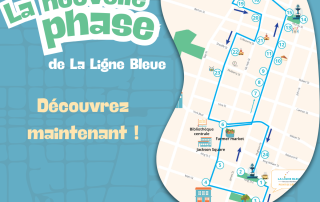
The Blue Line: Phase 2 Successfully Launched in Hamilton
Destination: Hamilton2026-03-31T14:55:35-04:00August 28, 2025|
On August 23, Hamilton was rocking to the beat
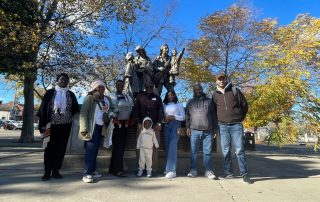
An Enriching Tour of the Ligne Bleue for French-Speaking Newcomers
Destination: Hamilton2025-08-12T13:59:48-04:00November 27, 2024|
Guided Tour of the Blue Line on November 7
With respect and gratitude
In a spirit of respect and truth, we honor and acknowledge that the city of Hamilton is located on the traditional territories of the Erie, Neutral, Huron-Wendat, Haudenosaunee, and Mississauga peoples. This territory is covered by the «Single-Spoon Plate with Wampum Belt» agreement. This agreement was entered into between the Haudenosaunee and the Anichinabe to share resources around the Great Lakes. We also acknowledge that this territory is covered by the 1792 ’Purchase Between the Lakes« agreement, concluded between the Crown and the Mississaugas of the Credit River First Nation.
Today, the city of Hamilton is home to many Indigenous peoples of Turtle Island (North America), and we recognize that we must do more to learn about the rich history of this land in order to better understand our role as residents, neighbors, partners, and stewards.
We stand in solidarity with Indigenous women, girls, transgender, and two-spirit people who have gone missing or been murdered.
Partners
Thank you to our partners for their support and commitment!


